Tyranny of the middle
20 May, 2026
Facing indecision we typically default to the average of our options.
What to buy, how to travel, where to live: we evaluate these choices on various axes like cost, quality, and convenience.
The far ends of each axis feels risky and unbalanced, while the middle feels safe and sensible. The less informed we are, the greater we feel the gravity of the middle.
Masquerading as safety nets, the middle-road, hedged-bets options are a trap. They teach us nothing about ourselves, our tastes, or the benefits and drawbacks of different positions on the axis. They suspend our conviction and keep us hanging in a neutral space between peak experience and hard-earned wisdom.
Products
To avoid tyranny: Solve your problem for the lowest cost or buy it for life.
Mid-tier products have no dignity, soul, or longevity. By design they keep us in a buying-loop of replacements and marginal upgrades. This is true for clothing, appliances, furniture, tools, vehicles, and hobby gear.
The principle here is to settle for very basic or commit to the very best.
Very basic is the most affordable way to reach one of three outcomes:
- It solves the problem
- You realise the problem didn't really need solving.
- You become desperate to upgrade, now knowing which features are critical.
If you landed on 1 or 2, congratulations. If you landed on 3, you can now buy for life.
Buying for life requires avoiding trends, not conflating price or brand "value" with quality, and learning basic maintenance. It’s a long-term relationship where you make a commitment of care and repair in return for reliability and delight. Plus, quality goods usually come with warranties or repair guarantees that ensure their longevity.1
It's about buying the best long-term solution regardless of the outlay. Boots theory says this is the most economical strategy over time regardless.2
This approach simplifies purchasing decisions greatly, saving time, brain power, and money. Better yet, it improves our knowledge of and relationship with the products that occupy our lives.
Travel
To avoid tyranny: Travel like a bum or travel like royalty.
Average travel is rarely memorable, restorative, or rewarding. The life-changing experiences we all want are found on the far ends of the axis.
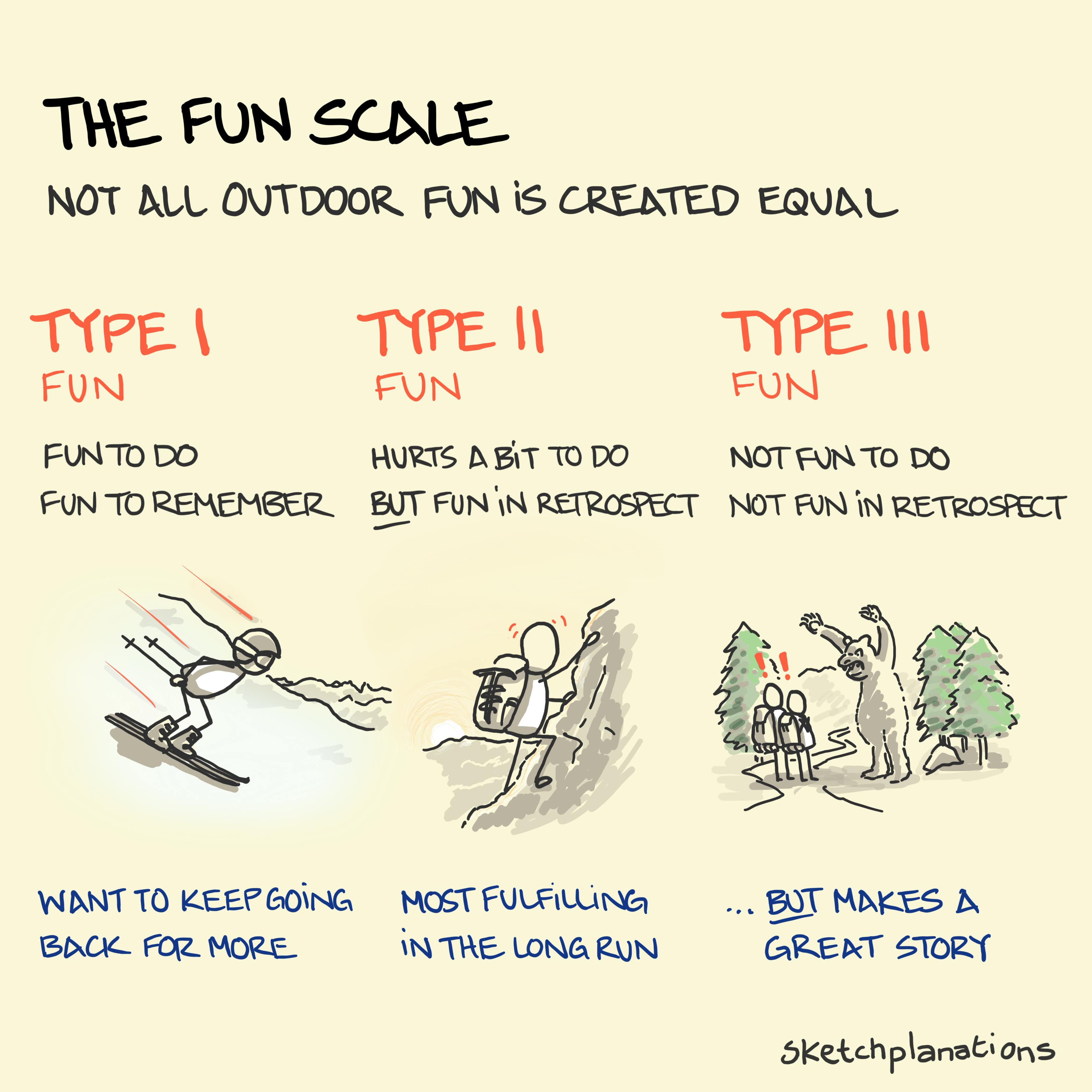
Bum-like travel is memorable for its authenticity. The itinerary is unplanned and spontaneous. It demands you be resourceful, adaptive, resilient, and present in your environment. You're more likely to get lost, get hurt, and be uncomfortable, but also more likely to befriend locals, avoid tourists, become immersed in the culture and gain a new perspective. Shoestring trips are high in Type 2 & 3 Fun, providing learnings, and stories to share for life.
At the other end, high-budget trips unlock world-class food, service, and unique stays where your enjoyment is mission critical. Or if you’re a more adventurous type, a high-budget gets you to the far reaches, the deep ocean, remote jungle, to Everest or Antarctica.
Mid-tier travel is unremarkable travel. One tight-ass trip with a flexible itinerary saves some cash to level-up the following one. Remember this before you consider a room in a middling Best Western.
Where to live
To avoid tyranny: Commit to the inner city or move to the country.
The outer suburbs are the middle of the home location axis.
They have the chaos and complexity of city life without the convenience; the inconveniences of country life without the community or serenity. Out there, its big mortgages, big commutes, and city evenings cut short to make the last train home.
One extreme is to prioritise location and buy or rent in the inner city, within a short walk from the things that make the city great. Even if that means a studio apartment, compromising on living space forces you out into it.
At your doorstep, the city's best restaurants, pubs, galleries, libraries, stadiums, architecture and parks. Observing the wierdness and the hustle. Enjoying the non-commute. Watching the future being built. Reveling in the unpredictable entertainment of the city.
The call for a quieter life may come. Most of us feel the need to stretch out and slow down at some point. Don't fall for the outer suburbs, instead jump to the other end.
Commit to a smaller town. Maybe coastal, maybe rural, but far from metropolitan. Job prospects may change, but you don’t need as much money. With a bit of luck, you will have clean air, quality neighbours, and a patch of land to call your own. All with added time and space for hobbies: to grow a garden, restore a bike, to paint or learn to kayak.
There are many satellite towns in close reach of a major city, so the city itch can be easily scratched.
Other Domains
The tyranny of the middle applies to many other domains, including career, education, and relationships.
Two obvious exceptions, where it's wisest to avoid the extreme ends, are politics and ideology. Better yet, avoid these domains completely.