Ways of Seeing
Seven essays (three of which contain only images) that reveal the societal impact of painting, and offers new ways to consider what we see.
Essay 1
How art is and should be experienced, and how mass reproduction has changed its role.
Seeing comes before thinking, but how we see is influenced by what we know or believe. There's a gap between what we see and what we know. They aren't always compatible e.g. our interpretation is influenced by our preconceptions of beauty, truth, genius, society, history, form, status, taste, etc.
Soon after we can see, we are aware that we can be seen. Dialogue is often an attempt to explain this reciprocity – to verbalise how you see things and discover how they do.
An image contains within it the artists way of seeing. In a painting it is the choice of colour or representation. In a photo, the perspective, angle, or lighting the photographer selects – what focus has drawn their eye.
An image is a record of how X saw Y. In the case of Hals' Regents and Regentesses of the Old Men's Alms House, it is the contrast of a destitute old painter commissioned to paint the aristocrats off whose "charity" he survives. The relationship between X and Y and the contrast of their lived experiences gives the image its significance. Not the style or arrangement or technical features alone. Analysing images only by the latter is dull "art appreciation".
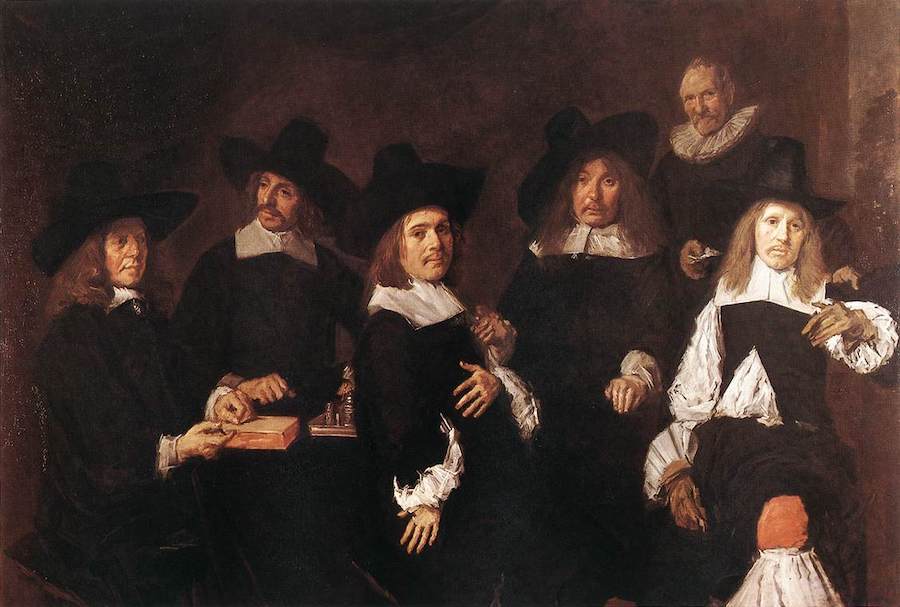
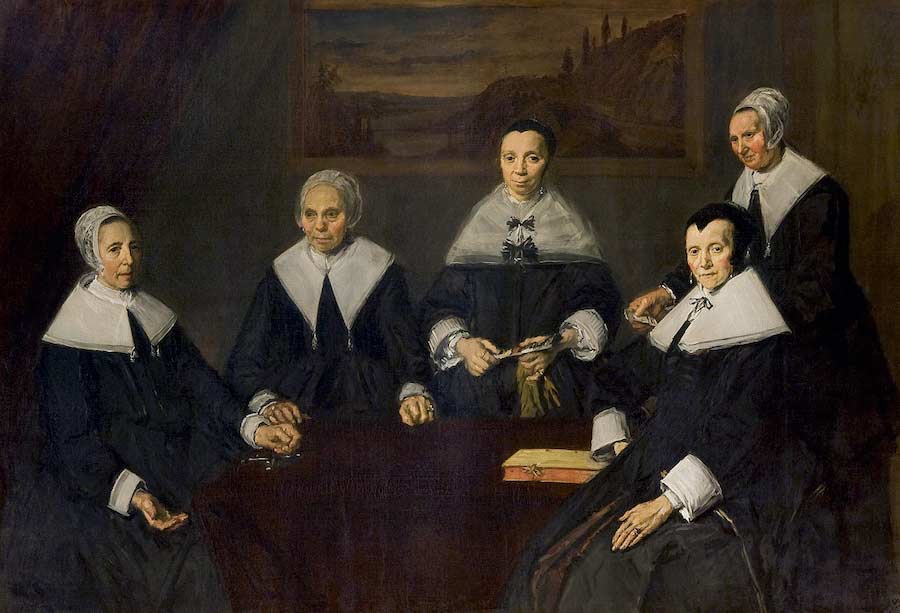 Regents (top) and Regentesses (bottom) of the Old Men's Alms House (Frans Hals, 1664)
Perspective drawings/paintings placed the viewer at the centre of the universe. Then, cameras showed that there was no centre. Awareness of this immediately influenced painting, first through the Impressionists, then the Cubists.
With the camera also came mass reproduction and mass transportability of paintings. Famous works could now be viewed from a couch in a living room, against a backdrop of an owner's furniture and mementoes. Detaching the work from its context fragments and diversifies its meaning. The meaning is changed according to what one sees immediately beside or before or after it. And through reproduction, the uniqueness of the original piece is no longer in what it says, but what it is. It becomes an object of rarity, with its value confirmed at auction. Through a certified origin story it becomes "art" and is treated as a holy relic but enveloped in bogus religiosity.
In the National Gallery catalogue, Leonardo's Virgin of the Rocks is dedicated 14 pages. None of which address the meaning of the image – they speak of who commissioned the painting, the line of ownership, legal squabbles, its likely date, etc. A few years ago (relative to 1970 when the book was published) Leonardo's cartoon of The Virgin and Child with St Anne and St John the Baptist was only known to scholars. It became famous because an American wanted to buy it for £2.5M. It has now acquired a new kind of impressiveness not because of what it shows, but because of its market value.
Art has been mystified by a privileged minority trying to justify the role of a ruling class – attempting to make inequality seem noble and hierarchies seem thrilling.
Following the painter's brushes closes the distance in time between the act of painting and the act of viewing. In this special sense, all paintings are contemporary.
The real question is this: to whom does the meaning of the art of the past properly belong? To those who can apply it to their own lives, or to a cultural hierarchy of relic specialists?
Imagine a world where art wasn't reproducible. Where galleries and physical collections were the only way to view the image.
For the first time ever, images of art have become ephemeral, ubiquitous, insubstantial, available, valueless, free. Its authority is lost. What matters now is who uses the language of images and for what purpose.
The past is not for living in
A film unfolds in time and a painting does not.
If we can see the present clearly enough, we will ask the right questions of the past
Like all information, it is put to use or ignored
Essay 2
A pictorial essay – images only.
How are women depicted through these images? As glamour dolls. Beauty. Clean. Pure. Sensitive. Self-aware. Self-absorbed. Self-obsessed. Sensitive. Sensual. Soft. Delicate. Smooth. Aesthetic. Comforting. Sheer. A prize to be won.
Essay 3
On the female nude painting.
Nakedness and a nude is different. Nakedness is to be without clothes in an innocent and raw sense. A nude in art is a genre with conventions that have, since the 1500s propagated the objectification of women. In most European nude paintings from the past 500 years, the woman is frontal and somehow subservient to the viewer-owner of the piece, presumably a man. This is not the case in African, Persian, Indian, Colombian nudes, where both sexes are one inseparable entity. The Western societal norm of a man's presence being equal to his power (an external possession) and a woman's equal to her own attitude about herself and what can and can't be done to her (an internal possession) is perpetuated by these paintings. The conventions are being challenged, though the residue remains.
Essay 4
A pictorial essay – images only.
Early paintings showed us immortality; the purity and innocence of women, children, angels, gods. Women as nurturing, caring, and protective, sharing a pure and holy bond with their child.
The focus then shifted to our collective mortality. Death, plague, disease, sin, humanity's fall from grace. Then, to why this suffering is justified. What it's worth, what are we seeking? The answer – simplicity and love. Even without these, you have nature and nature is abundant.
In portraiture, surrounding items are symbols. Spectacles, the type of hat, hairstyle, clothing, setting, what the subject is holding. These sum to our image of what this person did – their passion, profession, obsessions, and style. Facial and body expression often tells us about who they were, in what manner they carried themselves. Their attitude, mentality, and inner world.
By showing below their torso, the subject loses power and authority. Power is above the naval. Power is what is not shown – anonymity, mystery, intrigue. The unknown.
Essay 5
On the contradictions of the European oil painting tradition (1500–1900).
What is the tradition? In technique, precision and realism – replicating how we expect things to appear. In subject matter, mostly wealth and its products.
The contradiction is that those associated with the tradition – Rembrandt, Vermeer, Poussin, Brouwer – are not exemplars of such norms that define it. These masters are the great exceptions who evolved and separated from it. Unlike the majority, they did not idealise their subjects or promote materialism. Their paintings reveal the bitterness of reality or capture what others fail to – the intangible, metaphysical, and indeterminate.
Oil painting did to appearances what capital did to social relations: it reduced everything to the equality of objects.
The contradiction mirrors that of art and the market. During this period, as the art market expanded, the expression in an artist's work became less meaningful to him than the commission he received for the finished product. With a few exceptions, most paintings were painted for the wealthy class and to serve their interest. This is manifest in multiple forms, by depicting:
- wealthy people directly (portraiture, group scenes)
- things they owned or that their money could buy (still life, land, buildings, items)
- their idealised morals, nobility, behaviour (mythology, classics, antiquity)
- happy poor people, wealth being their source of hope (genre painting)
Perceived quality was proportionate to the fidelity of the image – how accurately is the subject reproduced on canvas? In this framework, symbolism evaporates. When everything is literal, the intangible, metaphysical, and indeterminate are inexpressible. The whole art form becomes shallow.
The exceptions to this generalisation have been mentioned. The list also includes Ruysdael, Hobbema, Chardin, Goya, and Turner.
The essay argues that these artists were not the masters of this art form, they were the rebellion against it. The European oil painting tradition was married to the market and thematically obsessed with material wealth. These artists were the original 'struggling artist' – a romanticised notion that existed only in Western art – because of their very rejection of this pursuit. In life they had few followers. In death, countless imitators.
Essay 6
A pictorial essay – images only
There is a glaring contrast in themes. In the first few paintings, we are confronted with slavery and subjugation. These are not protest pieces, they are almost archival – a record of everyday life as it were in Europe and America. These are interspersed with William Blake's surreal depictions of the spirits influencing nature and the human experience. We then have ordinary paintings of the upper-class; families, pets, homes, and the countryside. The final images are of women: in high society, as tempters, as witches, as goddesses.
Particularly through the lens of Essay 5, it's clear which paintings were for the market and which were to express a meaningful, complex, or otherwise important ideas. It's the difference between a technically 'fine' work and a remarkable and timeless one. Reminds me of a quote from Milton Glaser: "When something changes your view of the world, that is art."
Also, oil-painting your pet is the 19th-century equivalent of having an Instagram page for it.
Essay 7
A diatribe against consumerism and advertising. Discusses the visual language used by advertisers and what they have borrowed from oil paintings.
We take in hundreds of publicity images every day. Although there is competition between images – this drink versus that drink – they all make the same fundamental proposal: our happiness and goodness of life will increase if we buy something more.
Yet the image cannot focus on the object being sold, else the subject will feel distant from it. The focus instead must be the buyer. The buyer in the future, who is in a more enviable position than they are now, with better social relations and more authority and happiness.
In this way, publicity images must appeal to the moment and speak about the future in reference to the past.
Adverts commonly reference oil paintings and other well-known art, borrowing from them directly and indirectly. Directly, in the form of quotation or pastiche, lending cultural authority and dignity to the item being sold and placing it within the circle the buyer desires to be in. Indirectly, by using the same visual language:
- The gestures and roles of women and men
- The sexualisation and objectification of women
- Nature and the sea – innocence and new life
- Drinking as equivalent to success
- Materials and items of luxury
Although they borrow a lot, publicity images do diverge from oil paintings in one aspect: time.
Oil paintings speak in present tense, describing what the owner-spectator already has. In the future, people will look back on their present in envy.
Publicity images speak in future tense (a future that is never reached and continually deferred). In it, the buyer-spectator envies the future because it holds what they desire or long to be. Whatever is shown, it is a better alternative to the present. The present becomes insufficient. If they are envious enough of their possible future self, they will take the necessary steps to fulfil it. The effect is compounded when one's present experience is of interminable and meaningless hours of working. The working self envies the consuming self.
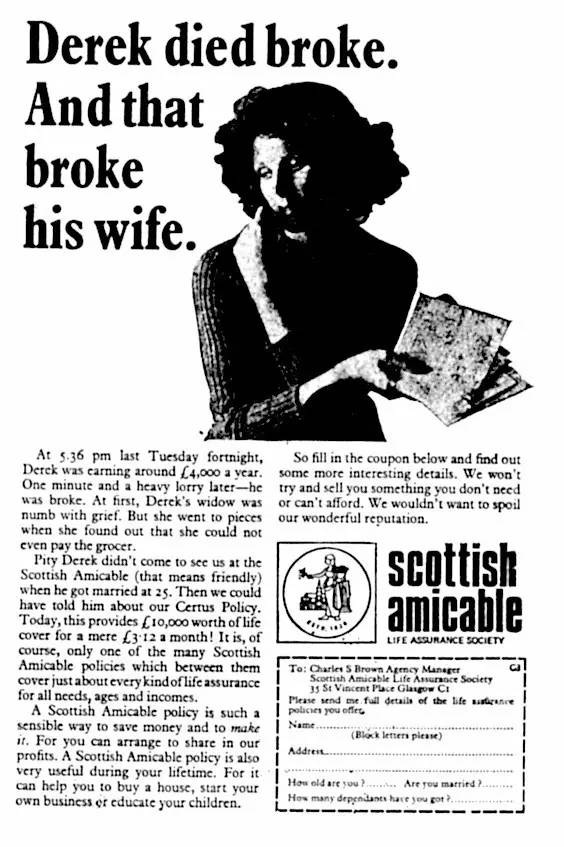 A ridiculous advertisement from the 60s
Publicity interprets the world for us. It masks over – and sometimes uses to advantage – what is unfair undemocratic in the world. But its offers are as narrow as its references are wide.
Publicity makes you believe "you are what you have"
Selling the past to the future
Profits are made twice over by the consumer: first as a worker then as a buyer
Being envied depends on not sharing your experience with others.
← More notesThe advertisement steals one's self-love as they are and offers it back at the price of the product.