The Back Pain Handbook
Chapter 1: The back pain story
Back pain is not an isolated story – it can impact your mental health and relationships. You need to tackle the physical, emotional, and compensatory habits to prevent an episode turning into chronic pain.
There are six chapters for exercises which map to a six week program:
- Neural exercises and hip flexors (c. 4)
- Core stability exercises (c. 6)
- Back, hips, and legs (c. 7)
- Neck, shoulders, midback (c. 8)
- Posture (c. 9)
- Advanced stability and using equipment (c. 11)
Try each set of exercises for a week at a time, noting which feel most beneficial. By the sixth week, you should be able to choose one of these or design your own tailored daily routine. All exercises are listed in Appendix II.
Chapter 2: Anatomy overview
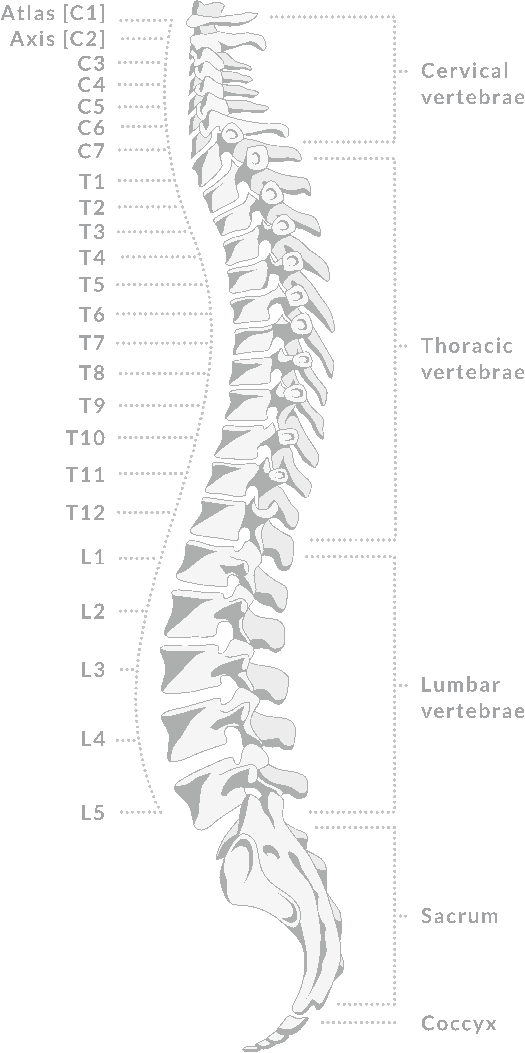
You have 226 bones and 450 muscles. The spine has 24 vertebrate: 7 cervical (neck), 12 thoracic (mid back), 5 lumbar (lower back).
Some muscles are for stability and posture (slow-twitch > fast-twitch). These are generally deeper, often activate subconsciously, and are not visible at the skin surface. When these are weak, you could tire from sitting or standing for extended periods. Examples include multifidus (spine), diaphragm (chest), transverse abdominus (abdomen), piriformis (rear hip).
Other muscles, called phasic muscles, are for larger movements (fast-twitch > slow-twitch). These include well known muscles such as hamstrings, calves, quads, and erector spinae.
Pain anywhere in the body inhibits our deep postural muscles and compromises spinal stability. Pain triggers the phasic muscles quickly, causing spasms, tightness, and locking.
Ongoing tightness in phasic muscles is usually a sign that the underlying stability muscles are weak. For example, weak piriformis and gluteus medius/minimus leads to tightness in the iliopsoas, hamstrings, and calves. Muscles can also adapt badly to strained or overstretched ligaments, unless given proper attention.
All parts of the body are important to solving back pain. Neck and shoulder pain is not independent from the postural muscles in lower back and legs. It is an interconnected system that must be treated holistically.
Personal note: In doing the postural alignment and stability test in this chapter, I noticed my left-foot balance was better than my right. I also noticed my foot was rotated slightly laterally – probably a consequence of the broken fibula I suffered in August 2013.
Chapter 3: Nerves and pain
Pain is physical and psychological. After an injury, retaining a worried and overprotective mindset can be counter-productive, leading to hyper sensitivity and activating the sympathetic nervous system. It slows recovery because the central "alarm system" stays active and triggers easily, even when there's no risk of injury. In recovery, rehabilitation, and through setbacks, your thought treadmill must remain optimistic. Starve your negative neurotags and feed your positive ones by focusing on what you can do, not what you can't.
Fascia is a tissue that connects nerves and muscles throughout the body. Lasting pain arises from neural tension caused by poor posture, muscular pressure, or a nerve getting "hooked" on fascial scar tissue formed after an injury. Neural tension can feel like muscle tightness, but the exercises to overcome this are different to regular muscle stretches.
There are motor, sensory, and autonomic (sympathetic and parasympathetic) nerves. Because of this, you may feel relaxed and altered sensations, and even quite emotional, after doing neural exercises.